 Independent Legal Risk Intelligence || Global Compliance Analytics || Research-Driven Insights


AI Governance in 2026: What Every Board of Directors Should Know
Why AI Governance Reaches the Boardroom in 2026
Artificial intelligence has moved from a technical tool to a board-level responsibility. In the 2026 Allianz Risk Barometer, AI rose to second place among global business risks, up from tenth in 2025. That jump was the largest in the ranking. Directors now face a duty they cannot delegate. Fiduciary standards, securities disclosure rules, and corporate law all point to the same expectation. Boards must understand how AI affects performance, risk, and legal exposure.
The financial stakes are large. One 2026 analysis estimates aggregate annual exposure from ungoverned AI systems at £1.6 trillion to £4.4 trillion globally, with tail scenarios higher. Five categories drive most of the expected loss: agentic AI failures, AI-enabled fraud and deepfakes, regulatory non-compliance, critical infrastructure incidents, and shadow AI. Each risk compounds across organisational layers at once. Older risk frameworks were not built to contain that pattern.
The Governance Gap
Boards recognise AI as a material risk, yet few have built the structures to oversee it. A 2026 study of TSX-60 listed companies found a clear gap between naming AI as a risk factor and integrating AI governance into corporate architecture. Directors often lack the technical literacy to evaluate AI systems. Research identifies three common failure modes. First, performative oversight, where boards approve AI strategies they cannot assess. Second, delegation without accountability, where AI governance shifts to management committees with no board follow-through. Third, risk blindness, where boards chase AI opportunity while underweighting bias, hallucination, adversarial attacks, and regulatory exposure.
This gap carries legal weight. Under established oversight doctrine, directors owe duties of care and oversight that extend to emerging risks. Scholarship in 2025 and 2026 treats board-level AI governance as a non-delegable obligation, not a discretionary advisory task. Boards that ignore AI risk may face liability if harm occurs and no oversight system existed.
The Regulatory Timeline
The EU AI Act sets binding deadlines that reach beyond Europe. Obligations for general-purpose AI models entered application in August 2025. High-risk system enforcement, including deployer duties, follows on a staged schedule. Regulatory sandboxes are mandated by 2 August 2026. The Act applies to any company that wants to do business in the EU market, so non-EU firms fall within scope. High-risk systems trigger documentation, risk management, human oversight, and cybersecurity requirements. Directors should confirm which of their systems qualify as high-risk and who holds deployer obligations.
Compliance is not only about avoiding penalties. Firms are expected to fold AI Act requirements into enterprise risk management systems. Boards that treat the Act as a one-off legal task, rather than an ongoing control, will struggle as enforcement expands.
Frameworks Boards Can Use
Directors do not need to invent controls from scratch. The NIST AI Risk Management Framework and ISO/IEC 42001 give boards recognised reference points for oversight. These frameworks assign oversight tasks to senior leadership and the board, and they map governance functions to concrete practices. The OECD AI Principles offer further guidance. Using an external standard helps boards show that their oversight is structured and defensible.
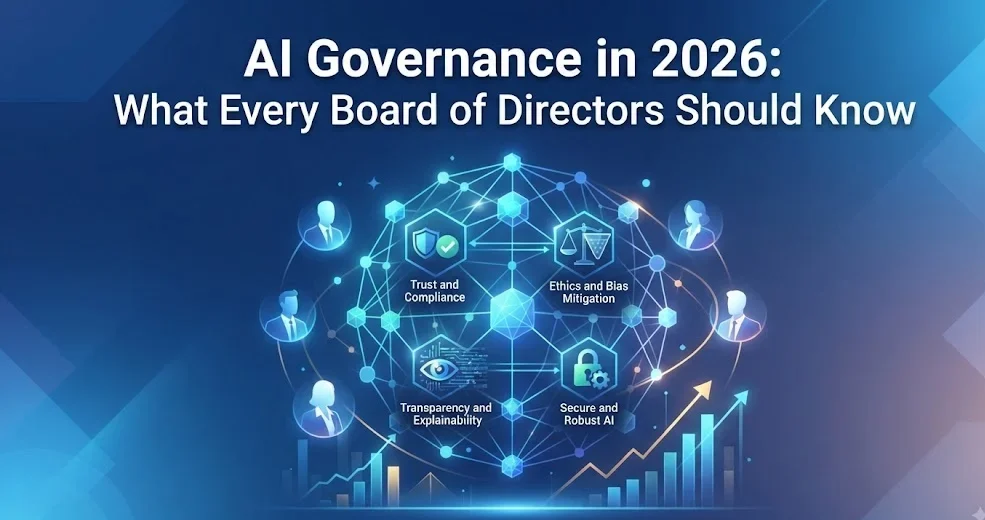
Proposed governance architecture is becoming more specific. Recent legal work recommends a standing board AI risk committee with clear oversight authority, a named AI fiduciary officer with escalation powers, and a tiered approval regime that requires explicit board authorisation for high-risk AI deployments. Other proposals add AI-literate board advisors, technology subcommittees with external experts, mandatory AI risk reporting cadences, and director education calibrated to board needs rather than vendor marketing.
What the Evidence Says About Payoff
Governance investment produces measurable returns. One 2026 assessment found that raising governance maturity from thirty per cent to seventy per cent reduces aggregate expected annual loss by roughly thirty-eight to fifty-two per cent across risk categories. The gains are largest where institutional controls bite hardest: regulatory non-compliance, agentic AI failures, and critical infrastructure. Risks driven by external adversaries, such as deepfake fraud, or by employee behaviour, such as shadow AI, respond less to internal governance alone. Boards should target investment where oversight yields the highest loss reduction.
A Practical Checklist for Directors
Boards should start with visibility. Maintain an inventory of AI systems in use, including shadow AI adopted without approval. Classify each system by risk and by regulatory status under the EU AI Act and other applicable rules. Assign oversight to a defined board committee and require regular AI risk reporting. Adopt a recognised framework such as the NIST AI RMF or ISO/IEC 42001 to structure controls. Require board authorisation for high-risk deployments and document the reasoning. Invest in director education so oversight is real, not performative. Review disclosure practices so that AI risk reporting to shareholders is standardised and honest.
The direction of travel is clear. AI is now a material driver of financial performance and legal risk. Regulators are setting hard deadlines, and the cost of ungoverned systems runs into the trillions. Boards that build structured, documented oversight will meet their duties and reduce exposure. Boards that treat AI as a purely operational matter leave the company, and themselves, exposed.