 Independent Legal Risk Intelligence || Global Compliance Analytics || Research-Driven Insights


AI Due Diligence: What Investors Should Check Before Buying an AI Company
Why AI Due Diligence Is Different
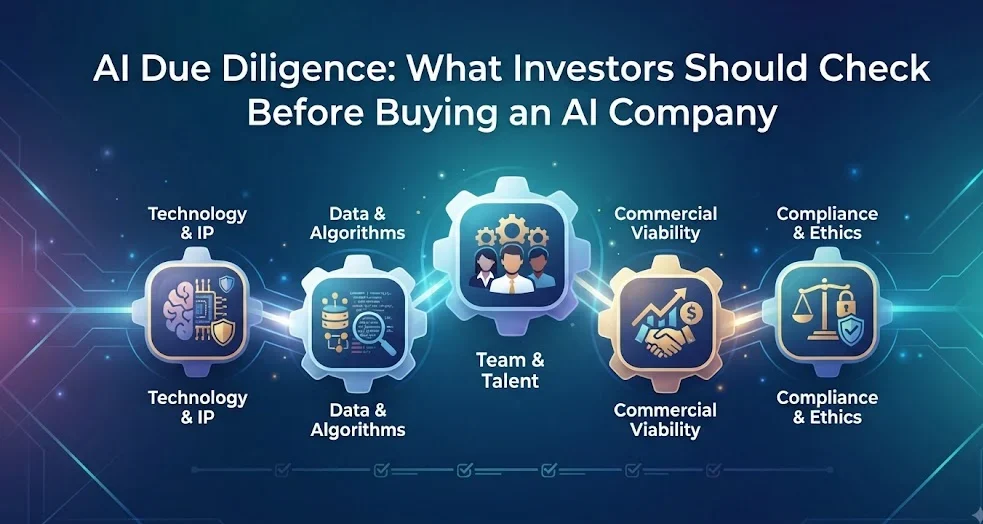
Buying an AI company is not the same as buying a standard software business. The value sits in assets that are hard to see and easy to overstate. Trained models, training data, and the people who built them carry most of the price. These assets degrade quietly. A model that performs well in a demo can fail once external parties demand proof of ownership, data provenance, or reliable performance. Investors who apply a generic checklist miss these risks. AI due diligence must test the technology, the data, the legal footing, and the team as one connected system.
The market has grown fast, and the pressure to close deals quickly raises the chance of error. Surveys of dealmakers show that adoption of AI tools inside the due diligence process itself has climbed sharply, from around 69 percent to higher rates within a few years. This speed cuts both ways. Faster review can miss the structural weaknesses that only surface under stress, such as a regulator request or an integration attempt. A disciplined process protects the buyer from paying for value that does not survive contact with reality.
Check the Data First
Data is the foundation of most AI companies. Training datasets and trained models now count as distinct intangible assets, separate from the code and the brand. Investors should confirm what data the company holds, where it came from, and whether the company has the right to use it. Ask for documented consent, licences, and records of collection. Weak provenance creates legal exposure and can force the removal of a product line after the deal closes.
Data quality drives model performance, so buyers should test it rather than trust it. Check for labelling accuracy, coverage of edge cases, and bias in the source data. Confirm that the company can reproduce its datasets and track versions. Poor data provenance is also a security issue, because unverified data opens the path to poisoning attacks that corrupt model behaviour. A buyer who cannot trace the data cannot value the model.
Assess the Models and Technical Debt
Model performance claims need independent testing. Ask for validation results measured against held-out data, and confirm those results are reproducible. Reproducibility is weak across the field; measurement studies of machine learning papers at top security conferences found that a large share could not be reproduced from the materials provided. If a research team cannot reproduce its own results, a buyer should treat the performance claims with caution.
Machine learning systems carry hidden technical debt. Configuration sprawl, undocumented pipelines, and tangled data dependencies raise maintenance cost and slow future development. Self-admitted technical debt is common in machine learning software and often concentrates in the code that prepares data and tunes models. Investors should review the engineering practices behind the models, including version control, monitoring, and deployment pipelines. A model that works today but cannot be retrained or updated safely is a liability, not an asset.
Review Legal, IP, and Regulatory Exposure
Intellectual property in AI companies can erode before any lawsuit. This loss happens in ordinary operations when an organisation cannot reconstruct who built what, when, and from which inputs. When a buyer demands proof of ownership or inventorship and the seller cannot supply it, the value falls. Buyers cannot easily tell a clean IP portfolio from a degraded one, which produces systematic undervaluation and failed deals. Investors should demand a software bill of materials, clear records of authorship, and evidence of trade secret protection.
Regulation now shapes AI value directly. The EU AI Act classifies systems by risk and places heavy documentation requirements on higher-risk uses. Buyers should confirm that the target maintains the technical documentation the law requires and that its products fit within permitted risk categories. Reliance on flawed AI-generated information during the deal itself can undermine the validity of the agreement, especially where the seller has misrepresented the technology. Explainability and clear records reduce this exposure.
Value the Team and Integration Risk
Much of an AI company’s capability lives in its people. Key researchers and engineers hold knowledge that is not written down. Investors should check retention terms, incentive structures, and the concentration of critical knowledge in a few individuals. If the team leaves, the models may become unmaintainable. Assess whether the workforce can retrain and adapt models as data and requirements change.
Integration risk deserves equal weight. Many acquired AI products never reach production inside the buyer’s environment because of data access barriers, infrastructure gaps, and governance friction. Investors should map how the target’s systems will connect to their own data and compliance processes. A realistic integration plan, with budget for data governance and MLOps, separates a productive acquisition from a stranded one.
A Practical Checklist for Investors
Buyers should build the review around concrete evidence, not assurances. Confirm data provenance and usage rights with documents. Test model performance for reproducibility against independent data. Audit engineering practices for technical debt and maintainability. Verify IP records, authorship, and a software bill of materials. Check AI Act classification and technical documentation. Assess team retention and single points of failure. Model the integration cost before agreeing a price.
Each check reduces the gap between the headline valuation and the value that survives the deal. AI assets fail quietly and late, so early scrutiny protects capital. Investors who treat data, models, law, and people as one system will price the company correctly and avoid paying for value that disappears under stress.