 Independent Legal Risk Intelligence || Global Compliance Analytics || Research-Driven Insights


What Investors Should Look for in a Company’s AI Risk Before Investing
Why AI Risk Now Sits at the Centre of Due Diligence
Artificial intelligence has moved from a support function to a core driver of revenue, cost, and liability. When investors assess a company that builds or deploys AI, they are no longer evaluating a technical feature. They are evaluating a source of financial risk. Research on market-based AI governance argues that AI risk and financial risk are now directly linked. Model failures, biased outputs, data breaches, and regulatory penalties translate into losses, write-downs, and reputational damage. Before committing capital, investors need a clear view of how a company identifies, controls, and discloses these exposures.
This guide sets out what to examine. It focuses on evidence, not promises. A company can claim responsible AI on its website. The task for an investor is to test whether that claim holds under scrutiny.
Governance Structures and Accountability
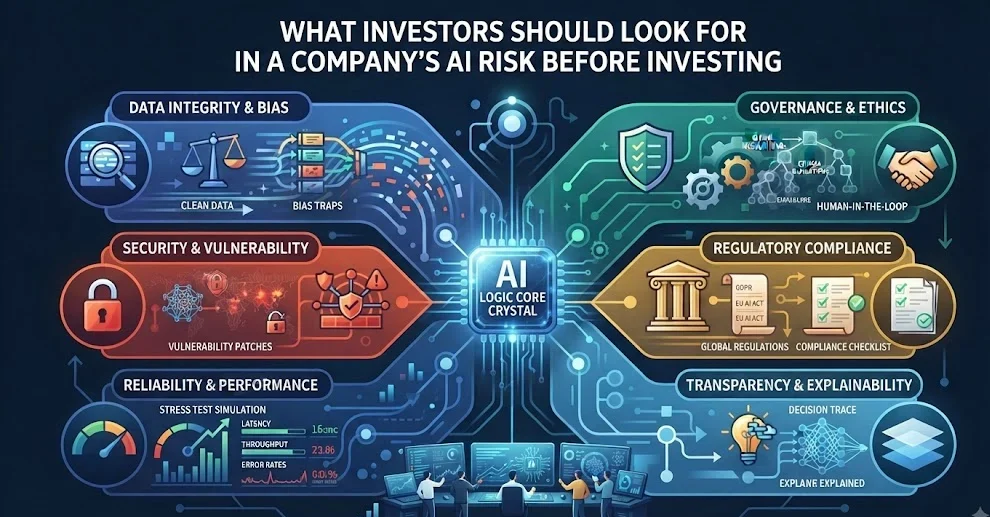
Start with who owns AI risk inside the company. Effective oversight requires named accountability at board and executive level, not a diffuse commitment spread across teams. Look for a defined risk taxonomy that covers both organisational risks, such as operational failure and legal exposure, and societal risks, such as bias and privacy harm. One enterprise governance framework consolidates these concerns into a set of 42 controls designed to address multiple risk scenarios and compliance requirements at once. The value of such a structure is that it reduces duplicated effort and closes gaps. Ask whether the company maps its controls to specific regulations. A framework mapped to a concrete law, for example the Colorado AI Act, signals operational maturity rather than aspiration.
Check for independent review. Internal sign-off alone is weak. Investors should look for evidence of audits, model validation, and documented testing before deployment. The presence of a governance function that can slow or halt a launch indicates that risk controls have real authority.
Regulatory Exposure Across Markets
AI regulation is fragmenting by jurisdiction. The European Union applies a risk-based model that places strict obligations on high-risk systems, including risk management, testing, and mandatory disclosure. The United States leans toward a market-based approach with lighter federal mandates and growing state-level rules. This divergence matters for any company that operates across borders. A firm selling into multiple regions carries the combined compliance burden of all of them.
Investors should identify which of a company’s AI systems fall into high-risk categories, such as those used in hiring, credit, healthcare, or criminal justice. These attract the heaviest obligations and the largest penalties. Ask whether the company tracks incoming rules and has budgeted for compliance. A firm that treats regulation as a fixed cost has planned ahead. A firm that treats it as a future problem has a hidden liability.
Disclosure Quality as a Signal
Disclosure is the clearest window into a company’s AI risk posture. Standardised, honest disclosure allows investors to price risk. Vague or absent disclosure hides it. Evidence from corporate reporting shows that markets reward transparency with higher valuations and lower cost of capital. In one study of listed companies, firms with strong disclosure came to command a majority of market capitalisation after reporting standards were introduced, rising from 43 to 67 per cent of total market value. The same research found that improved, technology-enhanced disclosure carried a financial performance premium well above that of traditional reporting.
For investors, the practical test is specific. Does the company disclose where AI is used, what data trains its models, how it monitors for failure, and what incidents have occurred? Disclosure that names concrete risks is more credible than disclosure that lists only benefits.
Data, Model, and Operational Risk
AI risk is grounded in data. Poor data governance produces biased, unreliable, or non-compliant models. Investors should ask where training data comes from, whether the company holds rights to use it, and how it protects personal information. Privacy exposure is a recurring barrier to enterprise AI adoption and a frequent source of regulatory action.
Model risk follows. A model that performs well in testing can degrade in production as conditions shift. Look for continuous monitoring, retraining schedules, and clear performance thresholds. Operational risk sits alongside. Concentration on a single external model provider, for example, creates dependency. If that provider changes terms, raises prices, or suffers an outage, the company inherits the disruption. Investors should map these dependencies before assuming a stable cost base.
Practical Signals for Investors
Turn the assessment into a checklist. First, confirm board-level accountability and a documented risk framework. Second, identify high-risk AI use cases and the regulations that govern them. Third, examine the depth and honesty of AI risk disclosure. Fourth, test data provenance, model monitoring, and third-party dependencies. Fifth, look for independent audits and evidence of past incidents handled well.
Strong answers indicate a company that treats AI risk as a managed cost. Weak or evasive answers indicate exposure that the market has not yet priced. The gap between the two is where investor losses tend to appear. Committing capital without this review means accepting risks that the company itself may not fully understand. A disciplined assessment protects returns and identifies the firms most likely to sustain them.