 Independent Legal Risk Intelligence || Global Compliance Analytics || Research-Driven Insights


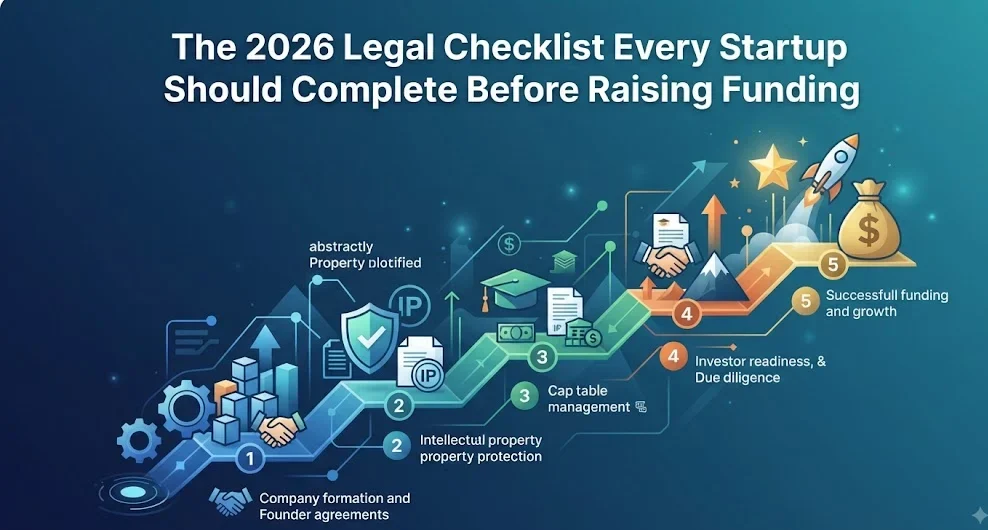
The 2026 Legal Checklist Every Startup Should Complete Before Raising Funding
Why a Legal Checklist Decides Your Round
Investors rarely walk away because the business is weak. They walk away because the paperwork is messy. Legal due diligence is where an investor’s counsel confirms that a startup owns what it claims to own: its equity, its intellectual property, and its contracts. A term sheet can be signed and the financials can look strong, yet a single missing signature can stall the wire for weeks.
The pattern repeats across every market. Founders build fast and document later. Then a lawyer sends a request list of forty items and the round slows while someone hunts for a contractor agreement that was never signed. The fix is cheap and boring: set the company up correctly at formation, keep the records current, and arrive with a tidy data room before the investor asks.
This guide walks through the 2026 legal checklist market by market: the United States, India, the United Kingdom, the European Union, and the Middle East. The core questions are the same everywhere. The filings, deadlines, and penalties are not.
United States
The default structure for venture-backed startups is a Delaware C corporation. Term sheets, SAFEs, convertible notes, and preferred stock are all standardised for this form, so counsel reviews it faster and cheaper. If you run a Delaware LLC, convert before you raise. A statutory conversion takes about five to ten business days once the Certificate of Conversion and Certificate of Incorporation reach the Delaware Division of Corporations, with a state filing fee of 89 dollars as of mid-2026. Most US venture funds cannot accept LLC membership interests because of pass-through tax problems for their limited partners.
The cap table must reconcile perfectly with board resolutions and stock purchase agreements. Every share, option, warrant, and convertible instrument needs a signed document and an approval behind it. Founder shares should sit under a vesting schedule, typically four years with a one-year cliff. Verbal equity promises to advisors are a red flag that must be papered or cleared before closing.
Two tax items carry hard deadlines. The 83(b) election must reach the IRS within 30 days of the grant, with no extensions and no exceptions; the clock starts at board approval, not at paperwork delivery. Before issuing any options, the company needs a current 409A valuation, refreshed annually or at each new round. Options priced below fair market value trigger immediate taxation plus a 20 percent additional federal tax under Section 409A, and that penalty lands on employees.
Intellectual property is the workstream that kills the most deals. Every founder, employee, and contractor who touched the product must have signed a Confidential Information and Invention Assignment agreement. A contractor owns their work product by default unless a written agreement assigns it to the company. Founders should also file Form D with the SEC within 15 days of the first sale in a Regulation D offering, and comply with state blue sky rules. Most rounds rely on Rule 506(b), which bars general solicitation and caps non-accredited investors at 35, or Rule 506(c), which allows solicitation but requires verified accredited investors.
India
Legal due diligence in India begins when the term sheet is signed, not before. A preliminary scan of two to five days checks Ministry of Corporate Affairs filings, the cap table, DPIIT recognition status, and founder backgrounds. The full track then runs six workstreams in parallel. Timelines scale with stage: one to two weeks for pre-seed, two to four weeks for seed, four to six weeks for Series A, and six to ten weeks for Series B and above.
Corporate records must be complete under the Companies Act 2013. Counsel checks the Certificate of Incorporation, the Memorandum and Articles of Association with all amendments, board and general meeting resolutions, the statutory registers under Sections 88 to 92, and the last three years of MGT-7 annual returns. Every allotment needs a Form PAS-3 filed within 15 days under Section 39, and preferential allotments need a special resolution under Section 62(1)(c). Discrepancies between the register of members and MCA filings are always treated as a closing condition.
The three core documents are the Term Sheet, the Share Subscription Agreement, and the Shareholders Agreement, and they must use consistent definitions and figures. Angel tax under Section 56(2)(viib) was removed for DPIIT-recognised startups from 1 April 2024, but the removal applies prospectively; allotments made before that date without a Rule 11UA valuation report create a legacy exposure that surfaces as a closing condition.
Foreign investment triggers FEMA obligations from the first rupee. Form FC-GPR must be filed with the authorised dealer bank within 30 days of allotment, the annual FLA return is due by 15 July, and Form FC-TRS within 60 days of a secondary transfer involving a non-resident. Penalties under Section 13 of FEMA can be compounded up to 300 percent of the transaction amount. Note that blanket non-compete clauses are unenforceable under Section 27 of the Indian Contract Act 1872, so employment drafting matters.
United Kingdom
UK rounds turn on a familiar document set: a term sheet, a share subscription or investment agreement, a shareholders agreement, updated articles of association, board and shareholder resolutions, and a disclosure letter. The term sheet is largely non-binding, but its commercial terms become the foundation for the definitive agreements, so founders should not treat it casually.
Before negotiating, get the basics in order. Companies House records, the registered office, and confirmation statements must be current. The articles often need replacing: basic model articles rarely carry the share class rights and transfer rules that investors expect, so companies commonly adopt investor-style articles at the round. Founder alignment should be documented through a founders agreement covering equity split, vesting, deadlock, and IP.
IP ownership is the recurring failure point. Founders who built the product before incorporation, and contractors who wrote code or designed the brand without written assignment terms, can leave the company without clear title. Fix this before an investor finds it. Warranties in the subscription agreement allocate risk, and a proper disclosure process against those warranties reduces founder liability later.
Key negotiated terms include reserved matters, share class rights, leaver provisions, and drag-along and tag-along rights. The BVCA model documents, revised in 2025, serve as a market-standard starting point. At completion, board and shareholder resolutions must be signed, funds received, shares issued, statutory registers updated, and the allotment filed at Companies House. A missed filing resurfaces when the next investor reviews the cap table.
European Union
The EU is not a single legal jurisdiction, so the structuring layer varies by member state, but the core checklist mirrors the UK and US: a clean cap table, documented governance, complete IP assignment, and a tidy data room. Founders raising across borders should confirm the entity type, the register filings in the country of incorporation, and the share class mechanics that local company law permits, since civil law systems differ on what rights can attach to shares.
Data protection is the workstream where the EU imposes the sharpest standalone risk. Any startup handling personal data needs a published privacy policy, a lawful basis for processing under the General Data Protection Regulation, and signed data-processing agreements with vendors. Investor counsel checks that actual data practices match the published policy, because the gap between the two is exactly what regulators pursue. Sector licences in fintech or healthcare are reviewed here too.
Convertible instruments work across most EU jurisdictions, but SAFEs sit less comfortably in civil law systems than in common law ones, so many founders use convertible loan agreements or convertible preferred shares instead. Change-of-control and assignment clauses in customer and vendor contracts deserve early attention, since a key contract that terminates on a financing complicates both this round and any future acquisition. Prior investor side letters, information rights, and pro rata rights should all be on the table before the term sheet is finalised.
Middle East
In the Middle East, and the UAE in particular, the first decision is jurisdiction, not the instrument. The UAE runs two legal systems side by side. DIFC and ADGM are common law financial free zones with their own courts and company laws modelled on UK legislation, where convertible notes, SAFEs, preferred shares, and full venture terms are enforceable. Mainland companies sit under federal civil law, where a SAFE is not recognised and does not fit the categories of shares or debt.
The standard build reflects this split. Startups place a holding company in ADGM, DIFC, or Cayman that carries the investors, the cap table, and the ESOP pool, with operating subsidiaries onshore or in other free zones. ADGM has become the regional default. Reorganising a cap table into a holdco mid-round, with diligence running, is the expensive path, so get the structure right at incorporation. Mainland LLCs generally cannot issue separate share classes without special approval, and a capital increase needs shareholder resolutions and formal steps.
Deal terms now converge on global venture practice: 1x non-participating liquidation preference as market, broad-based weighted-average anti-dilution, reserved matters, drag-along and tag-along rights, and ESOP pools of 10 to 15 percent with four-year vesting and a one-year cliff. Shareholders agreements at the holdco level typically take ADGM, DIFC, or English law with institutional arbitration.
Securities rules changed materially on 1 January 2026, when the Capital Market Authority replaced the Securities and Commodities Authority as the UAE federal regulator. A statutory prospectus liability regime under Article 29 now places personal liability on directors, executive management, and advisers, and administrative penalties reach up to 200 million dirhams or ten times the gain. Private raises must stay inside the exempt offer rules; a founder who markets a round to the public risks turning a private placement into an illegal public offer. In Saudi Arabia, preferred shares are permitted, but every instrument must comply with Sharia principles, which prohibit interest and contractual uncertainty, so guaranteed returns and interest-like features need careful restructuring.
The Shared Checklist Before You Raise
Five items travel across every market. Confirm the entity and its jurisdiction, and choose the structure investors expect, whether a Delaware C corporation, a UK limited company, or an ADGM holdco. Reconcile the cap table so every share and option traces to a signed document and a board approval. Close the IP gaps with signed assignment agreements from every founder, employee, and contractor. Meet the hard deadlines, whether the 30-day 83(b) election in the US or the 30-day FC-GPR in India. Organise employment records, material contracts, privacy documents, and all prior financing paper into one data room.
Legal readiness compounds. Every new investor’s counsel starts from zero, so the work done before the first request list is the work you stop redoing at every round and eventually at exit. Founders who treat this as a one-time setup, rather than a fundraise-time scramble, are the ones whose deals close on schedule.